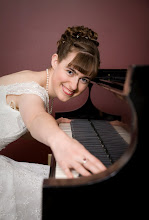
Well, for those of you who, like me, didn't know anything about this often under admired composer here is a brief introduction.
Biography
 Albert Pieczonka (pronounced pyeh-CHUN-keh) was born in Prussia in 1828. Albert studied in Leipzig and proportedly also studied for a time under Liszt - which would explain alot about his Tarantellas. In 1855 Albert married his sweetheart Nanny. They had, over the next few years, eight children, 7 girls and 1 boy. The Pieczonkas lived for a time in the late 50's in London and then in the 1880's, along with much of Europe, they immigrated to New York. After arriving in New York Albert formed his female brood into the Kempa Ladies' Orchestra. KLO toured over the next half decade and made quite an impression with their broad range of performance styles. Albert also continued to perform solo piano music and to compose. His L’Ame Perdue (The Lost Soul,) was written shortly after the loss of his youngest daughter, and is very moving. Pieczonka passed from this world at the age of 84 years. (Source: http://www.classical-composers.org/comp/pieczonka)
For a more complete biography check out this article from Clavier Companion.
Tarantella in a minor
Like the works by his teacher Liszt, Pieczonka's Tarantella in a minor shows a great deal of athleticism. As you already know, the native dance called the Tarantella stems from the ancient belief that a victim bit by a Tarantula could "shake out" the venom if he spun fast enough. The wonderful image of a desperate man spinning for his life is a great one to help students understand the mood of the piece.
Tarantella in a minor has an strangely incongruous middle section which is often described as the hardest part of the piece. After the mad frenzy of the pouncing opening we are left to wonder in the middle with a melodic line. It's as though our desperate imaginary character has gone into a delirious reflection.
I remember when I first played this piece the part I struggled with the most was the end. I could never get my fingers to move fast enough to produce the appropriate accelerando for the final death scene (or fainting scene, whatever you want to call it.) This is definitely one of those places where the old saying really applies, "Only play as fast as the hardest spots will let you."
My Favorite Version
 look inside
 |
Applause! - Book Two
(Impressive Piano Solos for the Budding Virtuoso). For solo piano. Graded Standard Repertoire; Masterworks; Piano Collection. Baroque, Classical Period and 20th Century. SMP Level 8 (Early Advanced). Collection. Introductory text, standard notation and fingerings (does not include words to the songs). 79 pages. Published by Alfred Music Publishing (AP.2538)
 (3)
...more info
(3)
...more info
|


