About Me

My photo
has been playing piano for over 15 years with training from some of America's best concert performers. My true love, however, is teaching with a fun twist.

Friday, April 13, 2012

Got Wacky Week?

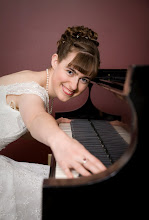
In honor of it being Friday the 13th, let's talk about how to be a weird piano teacher.

The last few weeks of lessons have always been a problem for me.  It isn't just the kids wanting to go outside and play, it's me too!  But I can't let my guard down and go with it since this is also the most crucial part of the school year for us.  

A few years ago I felt the whole studio sinking into this blue funk and I knew I had to do something to get us back in gear.  Thus was born "Wacky Week."

During Wacky Week all the student's preconceived ideas are turned on their head.  I usually wear flowers in my hair or something else unexpected like a costume.  We will do lots of games and play all our pieces "wacky" - in other words with tongues out, feet stomping, eyes shut, head bobbing, singing outloud.  Sometimes we will do unusual activities, like jumping rope to Beethoven.  

My kids loved it and I can't recommend it enough.

So do you have a Wacky Week tradition too? 
Photo Courtesy of dominiqueb

Wednesday, April 11, 2012

Happy Death Day, Albert Pieczonka!

April 12th marks the 100th anniversary of Albert Pieczonka's death.  Okay, I know what you're thinking, "Who on earth is Albert Pieczonka?"  No?  Really?  You already knew that Pieczonka is the composer responsible for Tarantella in a minor, one of the most popular teaching pieces of all time?  Wow, you are good.

Well, for those of you who, like me, didn't know anything about this often under admired composer here is a brief introduction.

Biography

Albert Pieczonka (pronounced pyeh-CHUN-keh) was born in Prussia in 1828.  Albert studied in Leipzig and proportedly also studied for a time under Liszt - which would explain alot about his Tarantellas.  In 1855 Albert married his sweetheart Nanny.  They had, over the next few years, eight children, 7 girls and 1 boy.  The Pieczonkas lived for a time in the late 50's in London and then in the 1880's, along with much of Europe, they immigrated to New York.  After arriving in New York Albert formed his female brood into the Kempa Ladies' Orchestra.  KLO toured over the next half decade and made quite an impression with their broad range of performance styles.  Albert also continued to perform solo piano music and to compose.  His L’Ame Perdue (The Lost Soul,) was written shortly after the loss of his youngest daughter, and is very moving.  Pieczonka passed from this world at the age of 84 years.  (Source: http://www.classical-composers.org/comp/pieczonka)
For a more complete biography check out this article from Clavier Companion.


Tarantella in a minor


Like the works by his teacher Liszt, Pieczonka's Tarantella in a minor shows a great deal of athleticism.   As you already know, the native dance called the Tarantella stems from the ancient belief that a victim bit by a Tarantula could "shake out" the venom if he spun fast enough.  The wonderful image of a desperate man spinning for his life is a great one to help students understand the mood of the piece.

Tarantella in a minor has an strangely incongruous middle section which is often described as the hardest part of the piece.    After the mad frenzy of the pouncing opening we are left to wonder in the middle with a melodic line. It's as though our desperate imaginary character has gone into a delirious reflection.

I remember when I first played this piece the part I struggled with the most was the end.  I could never get my fingers to move fast enough to produce the appropriate accelerando for the final death scene (or fainting scene, whatever you want to call it.)  This is definitely one of those places where the old saying really applies, "Only play as fast as the hardest spots will let you."


My Favorite Version


Applause! - Book Two look inside
Listen!
Applause! - Book Two (Impressive Piano Solos for the Budding Virtuoso). For solo piano. Graded Standard Repertoire; Masterworks; Piano Collection. Baroque, Classical Period and 20th Century. SMP Level 8 (Early Advanced). Collection. Introductory text, standard notation and fingerings (does not include words to the songs). 79 pages. Published by Alfred Music Publishing (AP.2538)
Smp_stars50 (3) ...more info

Monday, April 9, 2012

History Alive: King's Singers' "Masterpiece"

Have you been looking for a new way to explain music history to your intermediate students?  Me too!  

Aptly titled, "Masterpiece," this piece performed by the King's Singers is an a capella work designed to showcase the styles of most of the major composers.  The lyrics are filled with the composers' names and a few of the distinguishing dynamic, articulation preferences specific to each composer.

We had so much fun this week trying to figure out what they were saying and watching the King's Singers' humor.  Enjoy!

Know of another way to make Music History fun to learn?  Please share it with us!

Absolutely amazing, wasn't it?  If you are feeling adventurous you can find the sheet music for this performance here:

Masterpiece (Collection) look inside Masterpiece (Collection) By The King's Singers. By Paul Drayton. SATB. King's Singer's Choral. 44 pages. Hal Leonard #HMB165. Published by Hal Leonard (HL.8740325)
Smp_stars40 (2) ...more info

Friday, April 6, 2012

Go to Spots or My Performance Disaster

My High School Senior Recital was perhaps one of the most terrifying experiences of my life.  I had been playing piano for about 13 years at that point and had participated in MANY recitals.  But never before had the spotlight reflected off my sweating brow alone.

My piano teacher was very good at what she did.  She'd had me playing and performing my repertoire selection off and on for over 3 years in preparation for the big day.  (Mind you it was interspersed with ALOT of other material as well, so I didn't run screaming from boredom.)  And then when I had only a month left to go, she got me coaching lessons with one of the best college professors in the area.

I learned alot from those coaching lessons - such as how badly I needed them.  I wasn't playing easy repertoire (think 3rd movement of Moonlight Sonata) and I had problems with choking or just plain blanking in the middle.

The professor listened to me play for a while and then told me the simplest and yet probably the best advice I have ever received.  She said "When you practice this at home, learn the ending the best. And then have a few places in the middle of the piece you can go to in case you get lost."

Thankfully, I took her advice.  The piece she was specifically referring to was my Bach Fugue.  I memorized and practiced the last two lines with determination and then located different section openings in the middle of the piece and practiced them faithfully.  One of the tricks I used to do this was to randomly start from memory at one of the places, instead of the beginning.

So my big day came and it was beautiful.  I was to perform at a lovely local church with stained glass windows and old fashioned pews.  Practically everyone I knew was there, some even flying in from other states.  I couldn't believe this day had finally arrived.

Everything around me blurred as I walked towards the piano and sat down.  My world seemed to shrink to the size of the keys and my bench.  I played a Bach Prelude.  Flawless.  The tension in my shoulders dropped and I placed my fingers in preparation for my Bach Fugue.  I ran over in my mind quickly my checklist of "go to places."  Before I knew what happened my fingers had taken off and I was playing the opening.  But then the honeymoon was over and I totally blanked.  

I skipped to my first go to place.  Played, and then blanked.  Jumped to my second.  Blanked.  Third.  Blanked.  Finally I jumped to my last place - the last two lines - and I remembered the whole thing.  I completed the piece with a flair, got off the bench and bowed.  The rest of the recital came off without any major hitches.

I like to tell this story to my students every year.  I call it my performance disaster.  But really it wasn't a disaster, I did make it through the whole piece and from what I've heard from the people in the audience, they couldn't really tell that anything was wrong.  And that it completely thanks to my coach's sage advice, "Have places you can go to.  Know the end the best."

 What is the best advice you have received to help your playing?  Please share it with us!
Wednesday, April 4, 2012

April Music Deals

As a teacher, what with lessons, recitals, competitions, and group classes, you have plenty on your plate.  You know that to save money on sheet music you need to shop the deals.  But who has time to keep up with everything?  Clearly Piano Teaching is here to help!

April 2012 Music Deals


Hutchins & Rea: 20% off Durand and Salabert
                                 15% off Chamber Music
                                 40% off Overstock Scores

Sheet Music Plus HomepageSheetmusicplus.com: 20% off G. Henle Verlag

Musicforte.com : 10% off Everything (Ends 04/06) Free Shipping on Orders over $35.

Barnes and Noble : 40% off Country Music CDs

MusicRoom :  3 for 2 on Easy Play Today Books (plus Educator's 10% discount)
              Note: MusicRoom is a British company so beware the conversion difference.

Boosey and Hawkes : 15% off Karl Jenkins: The Peacemakers Score and CD combo

Shar Music : 50% off Inventory Sales Event (Ends 04/30)
               Note: Shar Music specializes in string sheet music.

Have I left out your favorite store?  Let me know!

Photo Courtesy of sciucaness

Monday, April 2, 2012

Death By Conducting?

Public Domain Image of Jean-Baptiste Lully
from Wikimedia Commons
Apparently conducting can be a very lethal activity.  During the 17th century conductors used large heavy sticks to pound out the time for the other musicians. Once, while conducting with just such an obnoxious stick, Jean-Baptiste Lully slammed the stick into his foot instead of the floor.  The wound caused by his mistake later became gangrenous and caused him to die.  Yes, it was death by conducting.


A woman walks into her doctor's office in the 17th century.
"Doctor, I keep hearing this pounding sound in my head.  It happens at all hours of the day or night!"
"Don't worry madam, that's just the conductor practicing next door."

Friday, March 30, 2012

March Post Round-up

This March has been full of surprises.  Whether you have watched election polls swish between candidates, weather run amok, or you have been, no doubt, baffled by how active the dreariest month of the year has turned out to be.  And the music teaching world has been no exception.  Here is a list a collection of my favorite blog posts from March 2012.

Marketing to Homeschoolers 
Blog: Wendy's Piano Studio
Wendy shares a wonderful collection of tips and tricks for marketing to the homeschool community.  I was a homeschooled student myself, so I can really relate to alot of the things she says.  The only addition I would make is that alot of homeschoolers use online groups, such as Yahoo!, to communicate and advertise so I highly recommend joining some of your local online groups.


Development of Piano Technique all bundled into one collection
Blog: Arioso7's Blog
Arioso7 takes a look at the beauty and practicality of teaching from Burgmuller's Twenty-Five Progressive Pieces.  I am a huge fan of teaching Burgmuller, particularly at the early intermediate levels.  I love how Arioso has broken down the technical aspects of each piece for us.


Tips on Memorizing Piano Music
Blog: Nola Piano Teacher
Although she is just starting out, I am already in love with Nola's Blog.  Her tips and tricks are spot on and very practical.  This post on memorizing tricks is chock full of helpful advice, some of which I have been using for years and some I am now going to start using ASAP.


Note Drop, Write, and Play- A Game from Cecilly
Blog: Susan Paradis' Piano Teaching Resources
If you have been following this blog at all then you already know that I am a huge fan of Susan Paradis' blog.  This game for identifying notes on the staff is definitely this month's favorite.  I love creative new ways to reinforce note reading!


You didn't think I'd leave us out, did you?  Well, your viewing has chosen and the most popular post from this month has been our comedic take on sight reading.  Don't forget to check it out?  So what would you like to see in our upcoming posts?   

Have I left out your favorite blog post?  Please share it with us!
Related Posts Plugin for WordPress, Blogger...